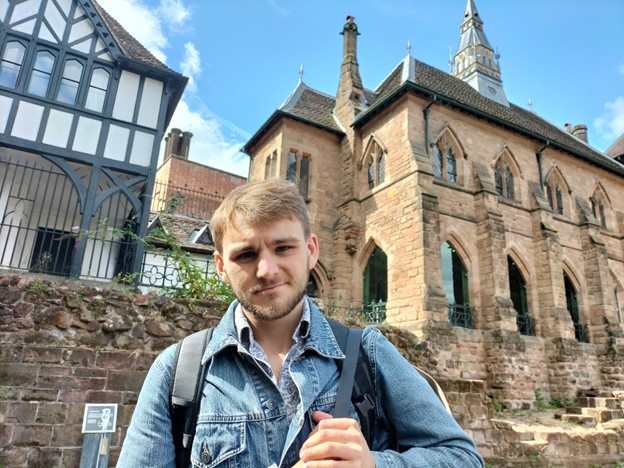
From Brighton England, Harbinger Magazine is interviewing Ed Prideaux. Ed is a writer and a musician. Let’s get started and hear what Ed has to say.
Thank you for doing this interview.
Thank you very much, David. It is an honor. I would never have predicted five years ago that David Bixby would be interviewing me!
Ed, where were you born and when did you start playing the guitar?
I was born in Guildford, Surrey, in the south-eastern part of England.
Guildford is a lovely place. It’s surrounded by a beautiful countryside we call the Surrey Hills. Guildford is historic. Think cobbled streets, an old castle, an antique clock, and a statue of George Abbot, who was the Archbishop of Canterbury and a famous Guildfordian.
Guildford’s reputation is mostly as an upper-middle class commuter belt town around London, populated by business executives and gilet-wearing mums. It has some rougher parts. It can feel a little suffocating. There isn’t much diversity. It’s certainly very different to where I live now in South London.
My heart warms thinking about Guildford. I remember one particular evening towards the end of my undergraduate studies, when I would soon be leaving home and getting my first job. It was a beautiful evening. I made sure to explore all the side roads and shops that had plastered my childhood. Burnt oranges from street lights and shuttering pubs lit up the high street. Bob Dylan provided a suitably reflective soundtrack. I don’t go back very often, but I love it.
I began playing guitar when I was sixteen. I’d tried to learn guitar when I was nine, but I lacked the patience. Funnily enough, playing Guitar Hero was quite decisive in getting me interested and exposed to more rock sounds. I began playing the video game again as a teenager and got pretty good, so I figured I could try the real thing. I had to, of course, because I was getting impatient to start playing Beatles songs. It took a lot of practice.
What kind of guitar do you have and are there any other instruments you play?
I have a Squier Stratocaster and an Ashbury folk acoustic. I got the Squier Strat the day after my last LSD trip. I was so impressed by the music I’d heard at the festival when I was adventuring that I decided I had to start a band. The band didn’t happen. But I was looking for something cheap and effective enough to channel the droney, drop-D modal playing I go for. The Strat was a great option.
The Ashbury folk guitar was a gift for my 19th birthday. Again, it was economical and gave a great sound. Most of my playing has been acoustic. Fingerpicking and vaguely ‘Eastern’ improvisations.
I also play piano. The piano came in not long after the guitar. I started on an app on my smartphone. The first song I learned was ‘Imagine’ by John Lennon. And with a naive ambition I have since lost, I decided then to learn the piano solo on ‘In My Life’ off Rubber Soul. Somehow, I managed a reasonable approximation! My piano playing is good to an outsider, but very average to someone who knows what they’re talking about. I cut my teeth learning all the chords to the songs on Pet Sounds, and later by painstakingly working out the vocal melodies to various songs I liked and incorporating them into the harmony. ‘Satellite of Love’ and ‘Perfect Day’ by Lou Reed were two songs that took a lot of patience to nail. I’ve forgotten them now!
Have you written any songs?
I have indeed. I first began trying to write songs when I was in my first-year at university. They were pretty measly. I remember ‘writing’ a song that was almost entirely ripped off from The Zombies’ ‘Hung Up On A Dream’ and presenting it as my own to the band I had. I did the same for ‘Heroin vs Prozac’ by the Brian Jonestown Massacre. They didn’t notice!
When second-year came along, I started writing more. Songs influenced by The Beach Boys, with a lot of major seventh and slash chords. I wrote one influenced by George Harrison and Tame Impala called ‘You Don’t Need A Friend To Tell You That You’re Not Really In Love’. That was written after I’d fallen in love with a woman I’d been on one ‘kinda date’ with. I was anticipating the reaction of my friends on telling them that I was really in love.
The writing took off that summer. I developed a bunch of songs based on keyboards, effect-laden guitar solos, and samples of drums and snippets of speech. It was all deeply influenced by LSD. LSD set the agenda for many, if not all, the songs I wrote over the next few years. I was simply shattered by the intensity of playing and listening to music while tripping. It felt rapturous, as anyone who’s taken the drug will agree. Over the pandemic, I wrote a load of songs in that rapturous vein: syntheses of blues and modes. I was also exploring my disillusionment with psychedelic drugs, which later crystallised into journalism and research I conducted on the drugs’ adverse effects. I try to focus on vocal melodies when I write now. It is easy for a heady person to get locked in theory and harmony, and lose track of the more intuitive and vulnerable place of searching for a melody.
One song I was pleased with was ‘William Blake Is In My Head’. I wrote that while trying to emulate a David Bixby style. It’s in Open G, with chords built on a droning G note, and lyrics that recall the Christian themes of Quetzalcoatl. I’ve written a few songs about faith, and the allure and internal struggle it produces: ‘Even So, Come’ and ‘Jesus Doubtin’ Blues’ are a couple.
Where are you going to college and what are your studies?
I went to the University of Warwick in the midlands of the UK to study Philosophy, Politics and Economics. My degree was incredibly wide-ranging. I had seminars on African politics, Ancient Greek philosophy, classical logic, econometric research, data analysis, the philosophy of art, etc.
You’ve written articles for the Guardian, tell us about that?
I began writing in the summer between my second and third year at university, writing about Pink Floyd, Skip Spence and Syd Barrett. After I graduated and got my first job, I wrote about 60s culture and history and soon got my first commissions in The Independent, The Guardian, The Financial Times and other publications. I got a job at Rebel Wisdom, a now-expired media channel in the UK that would broadcast punditry and dialogues about the existential dimension of issues in culture. So I started writing about big issues, like mass trauma, polarisation, culture war, and then psychedelics. For a couple of years, I developed real specialism in critical coverage of the emergent field of psychedelic psychiatry, analysing its neglect of risk, utopianism, corporate capture, and role in creating a consumer technicisation of ‘mystical experience’.
What are some of your favorite artists or bands?
I was just watching a documentary this morning about The Travelling Wilburys and ‘Handle With Care’ is stuck in my head. George Harrison and Bob Dylan and the entire class of 1965-1971 have been firm favourites of mine since I was sixteen. I got into music gradually via Pink Floyd, Wings’ Band on the Run, The Cure, New Order, The Velvet Underground and a smattering of sixties songs.
But the day I heard The Beatles’ Abbey Road, it honestly felt like I ‘woke up’. The effect on me was kind of shattering. I liked some Beatles stuff, so I thought, ‘Hey, I’ll give this a try while I do my physics homework’. I could not believe how good it was. I remember banging away on the table like a little drumming monkey when the suite of Mean Mr Mustard and She Came In Through The Bathroom Window, etc. kicked in. It was just incredible. From there, my love affair with The Beatles was afoot. I have been a passionate fan for the last decade and I read about them constantly (though I find details about tour dates and recording engineers and the second and third albums a little tedious).
My love affair kicked into high gear when I got really into Magical Mystery Tour, Revolver and Sgt. Pepper. I love the psychedelic stuff: it’s what set the agenda for me in my interest in and playing of Indian music, my firm basis in drones, and my consumption of LSD. That morphed into a broader passion for psychedelic, raga and garage rock of the 1960s and the present day. Favourite bands in this vein are Spacemen 3 (excellent drone minimalists), early Floyd, The Jimi Hendrix Experience, Tame Impala, The Brian Jonestown Massacre, The 13th Floor Elevators, Love, Black Sabbath, The Byrds, Can, Kaleidoscope, Ultimate Painting, Black Market Karma, Hawkwind, The Beta Band, Creedence Clearwater Revival, Television, The Grateful Dead. More broadly, I’m a fan of Nirvana, The La’s, Suicide, Sixto Rodriguez, John Coltrane, Black Country New Road, Leonard Cohen, Fairport Convention, The Band.
Share with us some of your goals and your plans going forward?
I have a wide range of interests in the esoteric, philosophy, theology, culture, music. I love writing and thinking about those, so I intend to keep doing that. I have worked a range of jobs and sometimes the distance from my passionate interests really took a toll on me. I think I’m probably on the autism spectrum, so if I’m not focusing a lot on my ‘special interests’, it’s like a gash in my chest. I just want to keep thinking about and feeling alive to my passions and to follow where that leads me. Oh, and also to have a house and start a family with my girlfriend. I love kids.
When did you first discover the Ode to Quetzalcoatl vinyl LP
When I was twenty-one. At that point, my appetites for psychedelic drugs had left me with some mental illness, in particular Hallucinogen Persisting Perception Disorder (flashbacks and neurovisual injury) and Depersonalisation-Derealisation Disorder (feeling like I’m in a dream, nothing seems real, everything seems fake, feeling disconnected from my body and everyone around me). That’s when my interest in the subgenre of so-called ‘acid casualties’ of the 1960s took off, and my discovery of that album. The song that hooked me was ‘Secret Forest’. I found the harmonica break to be a real declaration of freedom, both psychological and spiritual. I thought its use in the podcast documentary that was made about David was masterful.
Is there anything else you would like to say to our readers?
The instrumental section in Creedence Clearwater Revival’s ‘Ramble Tamble’ is awesome and a great song to run to.

– Dave Bixby
 Dave Bixby